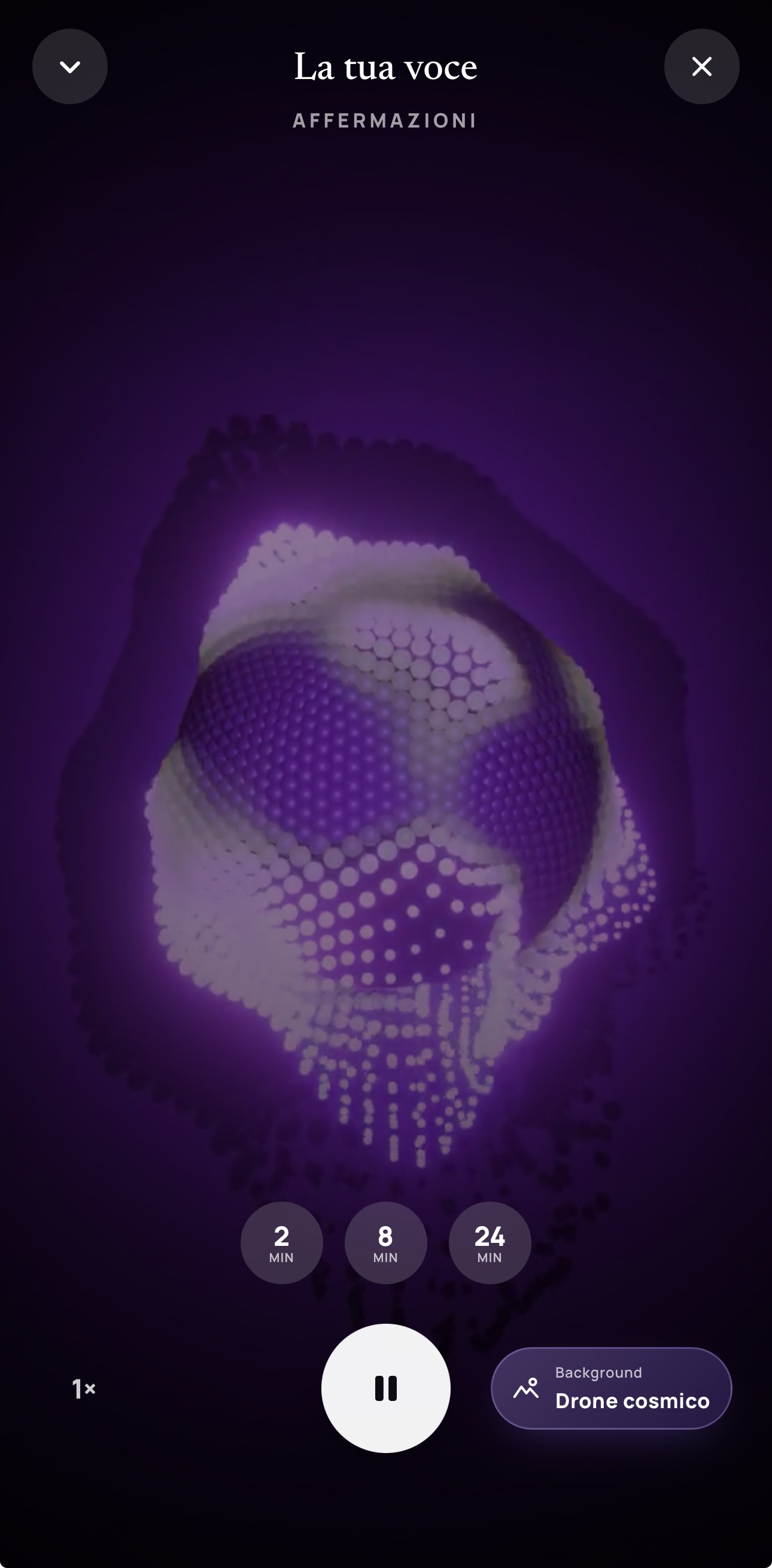
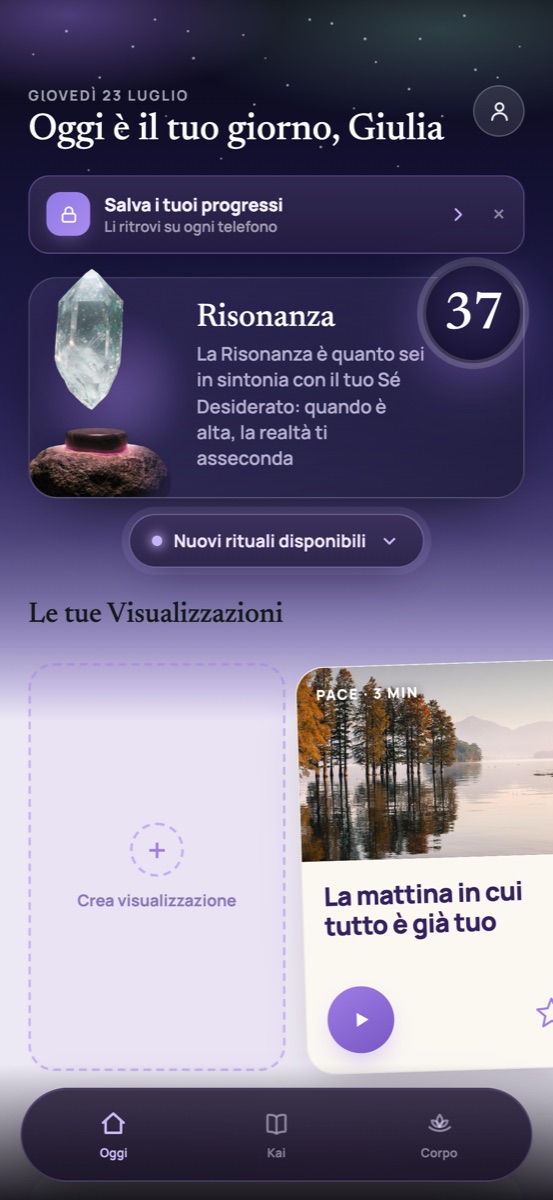
The Kagami Method (from kagami, 鏡, "mirror" in Japanese — in Italian, Metodo Kagami or metodo specchio) is a manifestation method built on 3 daily steps, practiced for 33 days, about 6 minutes a day. Unlike other methods, it doesn't ask you to believe: it asks you to measure. Every day, your Risonanza score (0-100) tracks how aligned you are with the person you are becoming.
Where it comes from
In Japanese tradition, a mirror doesn’t reflect your appearance: it reveals what is already there. The Yata no Kagami — the sacred mirror — is one of the three Imperial Treasures of Japan, and kagami biraki (“opening the mirror”) is the ritual that marks a new beginning. The Kagami Method starts here, with one simple idea:
Other methods make you ask for something you don’t have. The mirror makes you recognize who you are already becoming.The principle of the Kagami Method
The three daily steps
1 — Rifletti · the Mirror of the Voice (morning, ~2 minutes)
You record your affirmations once, in your own voice, and listen back every morning. Your brain gives privileged attention to what is yours — your name, your voice (Moray, 1959) — and remembers self-referenced information better than anything else (the self-reference effect, Rogers 1977).
2 — Rivedi · the Mirror of the Scene (evening, ~2 minutes)
Every evening you watch a vivid scene from your future life, built around you — and you close it with one small if-then action for tomorrow. A vivid future self drives better decisions today (Hershfield, 2011), but passive daydreaming alone drains energy (Oettingen) — which is why every scene ends with a concrete step.
3 — Riconosci · the Mirror of the World (during the day, ~2 minutes)
During the day you receive a Sussurro (a “whisper”): a simulated proof from your future, delivered like a notification. You answer it by spotting one real echo of your goal in your actual day. Selective attention does the rest.
The measure: Risonanza (0-100)
The Kagami Method is the only manifestation method with a counter. Risonanza measures, day by day, how in tune you are with your desired self: you don’t “feel” it working — you watch it grow. Expectations measurably shape perception and behavior (Kirsch, 1985); measuring them is the honest way to train them.
The first loop: 33 days
Day 1 is the opening of the mirror (kagami biraki): you record your voice. Then 33 days of the three steps, six minutes a day. Missing a day doesn’t reset anything — habit research says repetition over time is what counts, not perfection (Lally, 2010).
Why it works (no fairy tales)
The Kagami Method makes no medical claims and doesn’t mention quantum energies. It draws on documented psychology: privileged attention to one’s own name and voice (Moray 1959), the self-reference effect (Rogers 1977), self-affirmation measured with fMRI (Falk et al., PNAS 2015), future self-continuity (Hershfield 2011), mental practice (Driskell 1994), implementation intentions (Gollwitzer & Sheeran 2006) and habit formation (Lally 2010). And one thing other methods won’t tell you: visualizing alone sabotages you — passive positive fantasies reduce the energy available for action (Kappes & Oettingen, 2011). That’s why every step of the Method hooks back into reality.
The Method lives in Kagami
You can practice the three steps with paper and an alarm clock. But the Kagami app is built exactly for this: it records your voice once, shows you your future scene every evening, sends you the Sussurri and measures your Risonanza day by day. The app is currently available in Italian.